Case 02
Ask Allie · SMART Goals — Codex Health · 2025

Teaching an AI health coach to think like a clinician.

Building an AI conversation that does what static goal-setting never could — adapting to each patient the way a real clinician does.

Role
Sole designer · AI product lead
Collaborators
Clinical team, data science, engineering
Timeline
2025 · shipped
Status
Shipped · metrics on request

Goal-setting required a clinician in the room. It shouldn't.

Before Ask Allie, SMART goal-setting at Codex Health depended entirely on a clinician being present. They'd walk the patient through the process during a time-limited visit, or email a worksheet and hope the patient remembered to fill it out and return it. There was no way for a patient to set a goal on their own, track it in the app, or have Allie respond to their progress.

The opportunity was to change how care is delivered — not just improve a UX flow. If Allie could hold the goal-setting conversation the way a skilled clinician does, patients could set meaningful goals on their own time, track them independently, and give their clinician something real to work with at their next visit.

This was also the first AI feature in the platform to update a patient's care plan. The stakes were higher than a typical design problem.

The right model wasn't in a textbook. It was in the room.

We started by interviewing our clinical team — what do they believe makes a great SMART goal? They described a thorough, structured process: walk the patient through each letter, make sure every component is covered. That became our first training approach.

We also ran mock goal-setting sessions between clinicians and employees, designed to simulate what a health coach would do. Those sessions were helpful — they captured the warmth and adaptability of a real coaching conversation — but they were also long, unhurried, and focused entirely on goal construction. They didn't reflect the reality of a clinical visit.

What clinicians actually do in a time-limited patient visit is something different. Faster. More intuitive. They acknowledge barriers early. They don't walk through every letter. They focus on getting the patient to a goal that's close enough and achievable — something that gets them moving — rather than constructing a perfect SMART goal from scratch.

The key insight
The difference between what experts say is ideal and how behavior change actually happens in the room. Allie needed to learn from both — and find the version that worked for patients.

We trained Allie on the idealized version, not the real one.

I made a mistake early in this project. I trusted the clinical team and the data scientist to structure the conversation based on what they believed was clinically correct — and I didn't push hard enough on whether that translated to a good patient experience.

The result was a conversation that walked patients through every letter of SMART in sequence. Technically thorough. Practically too long. Patients dropped off before finishing. The output wasn't meaningfully better than a much shorter conversation would have produced.

Before — too long
Walk through every letter
  • Explain what a SMART goal is
  • Define each letter in sequence
  • Ask the patient to fill in each one
  • Confirm the assembled goal
  • Patients dropped off mid-conversation
After — tightened
Brief intro, then S · M · T
  • Quick framing of why a goal helps
  • Specific — what will you do?
  • Measurable — how will you know?
  • Time-bound — by when?
  • More patients completed goal-setting

A conversation that felt like a coach, not a form.

The final conversation was shorter, warmer, and barrier-aware. It acknowledged what the patient was up against before asking them to commit to anything. It produced goals that patients actually tracked — because they felt like their own, not something filled out on a worksheet.

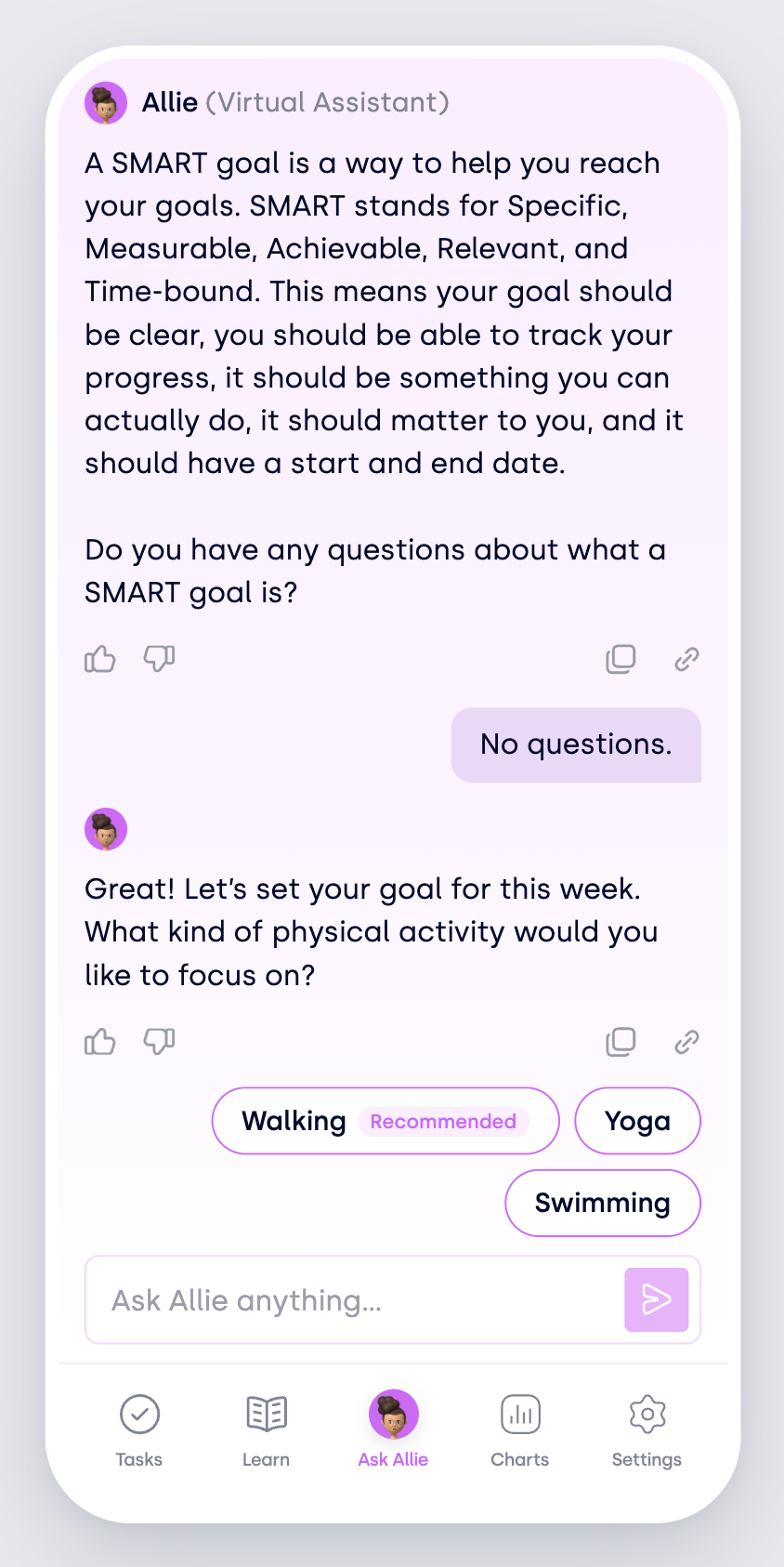
Ask Allie chat screen — Allie introduces the SMART goals framework and asks what goal the patient wants to set
Opening the conversation
Continuation of the Ask Allie chat — the patient and Allie work through what (running), how much (3 to 4 miles), and how often (3 days this week). Allie confirms the resulting goal: "I will run 3-4 miles, 3 times this week."
Setting the goal
Tasks screen showing the saved SMART goal — "I will run 3-4 miles 3 times this week" — tracked across the week with progress and related daily tasks
Goal added to Home screen

This changed how clinicians and patients work together.

The shift wasn't just about a better UX flow. It fundamentally changed the relationship between patients and their care team.

Before
Goals required the clinician.
Goal-setting only happened during time-limited visits or via worksheets that patients rarely completed and returned.
After
Patients set goals on their own.
Patients can now set meaningful goals independently, track progress in the app, and adjust with Allie's guidance — no clinician required.
The shift
Better visits, richer data.
Clinicians enter visits with real goal data already in hand. The conversation changes from "let's set a goal" to "here's how last week went — what's next?"

More patients setting goals. Less time to get there.

Cutting the conversation to S · M · T reduced the time to set a goal significantly and increased the number of patients who completed goal-setting. We had a clean cohort to study: whether setting and completing a SMART goal correlated with health outcomes — that analysis was in flight when I left.

The full metrics aren't public, but I'm glad to walk through them in person.

Want the full case?
Get in touch →
Next case
Redesigned patient onboarding screen — care team introduction with a clear call-to-action button
03
A small change. A full-funnel win.
Patient onboarding — found the drop-off no one was tracking and lifted end-to-end completion.